
Your Safety Net in Crisis: Essential Questions to Ask Before Spending Your Emergency Fund 🏦
In an era marked by an alarming rise in unexpected events, the importance of a financial safety net has never been more acute. However, tapping into your emergency fund is a decision not to be taken lightly. This article will provide you with crucial questions to ask yourself before spending your emergency fund, underlining the urgency and the gravity of the situation at hand.
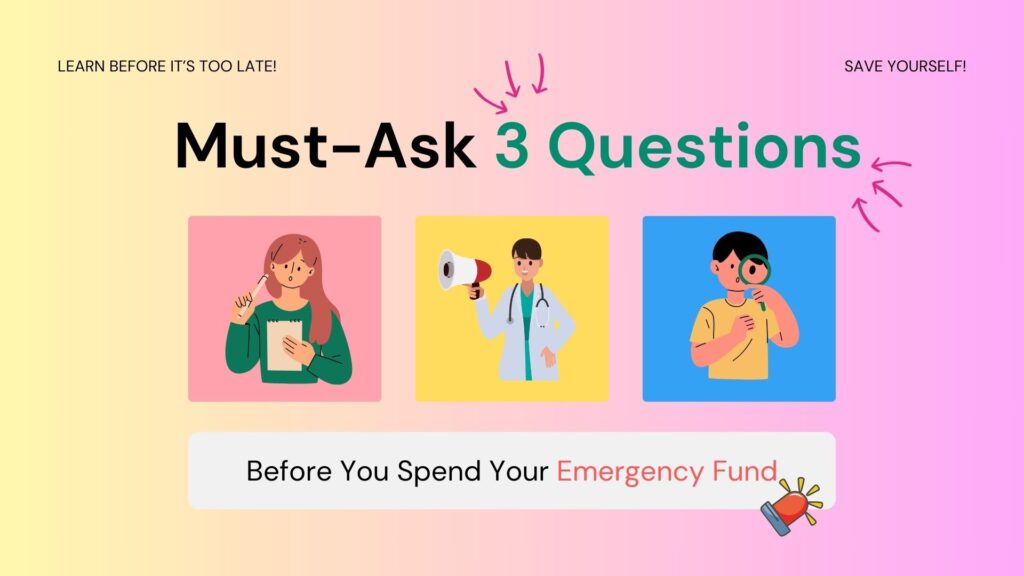
Quick Summary: Emergency Fund Checklist: 3 Questions to Ask Before You Pay
Tapping into your emergency fund is a significant financial decision that shouldn’t be made in haste. This guide helps you protect your safety net by evaluating your situation through three critical lenses:
Is it a True Emergency? Learn to distinguish between “urgent” desires and actual crises, such as job loss, medical emergencies, or critical home repairs.
Have Other Options Been Exhausted? Before dipping into savings, consider temporary expense cutting, selling unused items, or utilizing zero-interest credit options.
What is the Long-Term Impact? Understand the risks of depleting your “financial insurance” and the importance of having a clear replenishment plan to stay prepared for the future.
The Bottom Line: Your emergency fund is a lifeline designed for storms—respecting these boundaries ensures it stays intact for when you truly need it most.
If you are not sure whether you need an emergency fund, you must read this post: Why you need an emergency fund!
1. Is This a True Emergency? 🤒
Before you even approach your emergency fund, it’s essential to determine if the situation truly constitutes an emergency.

📌 Define an Emergency
Not everything that feels urgent is an emergency. An emergency is an unexpected and serious event requiring immediate action, such as a job loss, medical emergency, or critical home repair.
- Is this situation unexpected?
- Does it require immediate action?
- How serious is it?
If your situation fits these criteria, you may be facing a true emergency.
Examples of emergencies
✅ True Emergency (The Green Light): Your primary vehicle breaks down, and you have no other way to get to work. This is a threat to your income.
❌ Not an Emergency (The Red Light): There is a massive “Black Friday” sale on a TV you’ve wanted. While it’s a “limited time” offer, it isn’t a crisis.
⚠️ The Gray Area: Your refrigerator stops working. This is usually an emergency because food spoilage leads to more financial loss.
2. Have I Exhausted Other Options? ✅
Even if you’re in a crisis, it’s vital not to overlook other potential funding sources before dipping into your rainy-day fund.

📌 Explore Alternatives
Alternatives may include cutting back on non-essential expenses, selling unused items, or using a zero-interest credit card.
- Can I reduce my expenses temporarily?
- Are there unused items I can sell?
- Would a zero-interest credit card be a feasible option?
If you’ve exhausted these alternatives, then tapping into your emergency fund might be your next step.
Examples : Alternatives
The “Side Hustle” Sprint: Instead of taking $500 from your fund for a minor dental bill, could you work 10 hours of overtime or sell that old treadmill on Facebook Marketplace this weekend?
The “0% APR” Bridge: If you have a high credit score, using a 0% introductory APR card for a necessary $2,000 repair can be smarter than depleting your cash—if you have a guaranteed plan to pay it off before interest kicks in.
3. How Will This Impact My Financial Health? ❤️🩹
Remember, an emergency fund is an insurance policy, not an extension of your bank account. By using it, you expose yourself to potential future risks.
📌Assess Future Risks
To assess future risks, consider:
- How much will this deplete my fund?
- How quickly can I replenish it?
If you anticipate a significant impact on your financial health, consider seeking professional advice before making the final decision.
Opportunity Cost
The “Double Whammy” Risk: If you spend $3,000 of a $5,000 fund on a non-essential “urgent” repair, and then lose your job two weeks later, you only have $2,000 left for survival. You’ve traded your long-term security for a short-term fix.
The FI (Financial Independence) Delay: Every dollar taken out of your safety net is a dollar that isn’t being invested in the market. Frequent “emergencies” are the #1 reason people fail to reach their Rule of 25 goal.
4. (Bonus) Am I Prepared for Future Emergencies? 🚨
Although emergencies are unpredictable, it’s crucial to prepare for the next one, even while navigating the current crisis.

📌 Plan Ahead
Maintaining replenishment plans for your emergency fund is as important as having the fund itself.
- Will I be able to recover this amount swiftly?
- Do I have a plan to replenish my savings?
If the answer to these questions is no, this could be a red flag.
Ready to crunch your numbers?
Real-Life Scenarios: Preparedness in Action
The “Rebuilder” Strategy (Prepared): After spending $1,200 on an emergency medical bill, Sarah immediately adjusts her budget to redirect $200 a month back into her savings. She treats this as a “mandatory bill” to ensure her safety net is fully restored within six months.
The “Limping” Safety Net (Unprepared): John uses $3,000 for a car transmission repair but makes no plan to replace it. Three months later, he loses his job. Because he didn’t prioritize replenishment, he now only has a fraction of the funds he needs to survive the job hunt, forcing him into high-interest debt.
Conclusion: Respecting the Emergency Fund 🏁
In times of financial crisis, your emergency fund is a lifeline. However, access to this fund should not be taken lightly. Asking yourself these essential questions will guide your decision-making process and give you the best chance of weathering the storm while preserving your safety net intact.
"Your emergency fund is a beacon during financial storms. Guard it wisely."
- A future emergency Tweet
FAQ
1. What is considered a true financial emergency?
A true financial emergency is an unplanned, essential expense that cannot be delayed. Common examples include sudden job loss, urgent medical procedures, or critical home repairs (like a leaking roof or broken furnace). Non-emergencies typically include seasonal sales, planned vacations, or social events.
2. Should I use a credit card instead of my emergency fund?
Using a credit card is only recommended if you can utilize a 0% APR introductory offer and have a guaranteed plan to pay it off before interest kicks in. In most cases, using your emergency fund is safer than accruing high-interest credit card debt, which can worsen your financial situation.
3. How much of my emergency fund should I spend at once?
You should only spend the absolute minimum required to resolve the immediate crisis. Before tapping the fund, try to reduce the cost by negotiating the bill or selling unused items. Always keep as much of your “safety net” intact as possible to protect against a second, simultaneous emergency.
4. How do I start replenishing my emergency fund after using it?
- Start by treating your replenishment like a mandatory monthly bill. Redirect “fun money” or non-essential subscriptions toward your savings until the fund is restored to its original level. For more details on building this back up, see our guide on Why you need an emergency fund!
What's Next : take action today
- Learn why you need an emergency fund: Emergency Fund; A way of worry-free life. (What, why, and how)
- Use the Consumer Financial Protection Bureau (CFPB)s guide to prepare your emergency fund: An essential guide to building an emergency fund
- Tips for managing your emergency fund: Tips for Making and Managing an Emergency Budget

1 thought on “What are Three Questions to Ask Yourself Before You Spend Your Emergency Fund?”